
| Offered As | Single, 2 Count, 3 Count |
|---|

Scolopendra dehaani
Centipedes, InvertebratesIndonesian Cherry Centipede (Scolopendra dehaani) For Sale
Price range: $140.00 through $385.00
Field collected Scolopendra dehaani — the Indonesian Cherry, deep red bodied with contrasting legs. Arriving at roughly 4–6 inches. Not captive bred. This is one of the better first scolopendrids for a keeper stepping up from millipedes, because it is widely available, hardy and well documented — it is still venomous and still never handled.
Venomous. Advanced keepers only. Scolopendrids are fast, defensive and are never handled. House singly in a tightly latched enclosure — a centipede will exploit any gap it can flatten into.
Deep moist substrate, a cork hide, a shallow water dish, and roaches or crickets every 5–10 days.
Quantity-managed listing: the specimen you receive is representative of the group, not an individually pictured animal.
Related products
- Centipedes
Giant White Beard Centipede (Scolopendra sp. ‘White Beard’) For Sale
Price range: $425.00 through $1,170.00 This product has multiple variants. The options may be chosen on the product page - Invertebrates
Yellow Leg Millipede (Spirostreptid sp.) For Sale
Price range: $100.00 through $325.00 This product has multiple variants. The options may be chosen on the product page - Invertebrates
Inferno Leg Millipede (Alienostreptus bicoloripes) For Sale
Price range: $100.00 through $325.00 This product has multiple variants. The options may be chosen on the product page - Centipedes
Orange Leg Mt. Merapi Centipede (Scolopendra cf. dehaani) For Sale
Price range: $265.00 through $730.00 This product has multiple variants. The options may be chosen on the product page

Care questions
- What does this centipede eat?
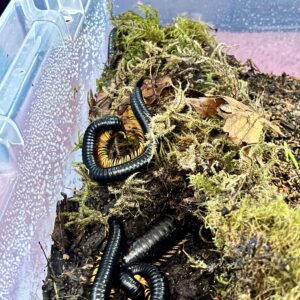
- Millipedes, and effectively nothing else. Edentistoma octosulcatum is a dietary specialist and will not reliably accept crickets or roaches. A supply of appropriately sized feeder millipedes needs to be established before the animal arrives, not after.
- Why does it look like a millipede?
- Because that is how it hunts. The flattened, heavily armoured body lets it move among millipedes without triggering their defences — one of the clearest cases of aggressive mimicry among the centipedes.
- Is it venomous, and can it be handled?
- It is venomous, as all centipedes are, and it is not a handling animal. Unusually for a scolopendrid it moves slowly, which makes it easier to work around, but the enclosure still needs a secure escape-proof lid.
- What setup does it need?
- A terrestrial enclosure with moisture-retentive substrate at moderate depth, flat hides and cork bark that mimic the leaf-litter habitat it lives in. It is secretive and will spend most of its time concealed.
- How escape-proof does a centipede enclosure need to be?
- Completely. Centipedes are strong, persistent and can exploit a gap far smaller than they look capable of. Use a locking lid, seal cable and vent gaps, and check the enclosure every time it is opened. Full centipede care guide.
- Are centipedes dangerous to keep?
- They are venomous and the larger species deliver a genuinely painful bite. They are not handleable animals under any circumstances. Work with tongs, keep the enclosure secure, and treat them as a look-only species.
- What do centipedes eat?
- Live prey, usually appropriately sized insects. Some specialists are far narrower than that — the millipede-eating species we stock will not accept normal feeders, and its listing says so explicitly. Read the specific listing before ordering.
Reviews
There are no reviews yet.