| Offered As | Single, Pair, 3 Count |
|---|

Correlophus sarasinorum
GeckosSarasinorum Gecko (Correlophus sarasinorum) For Sale
Price range: $600.00 through $1,650.00
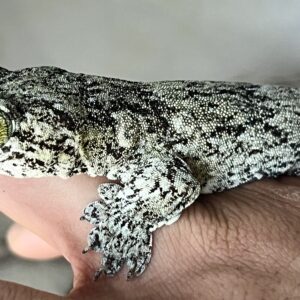
Captive bred Correlophus sarasinorum — also traded as Roux’s Giant Gecko. The less common of the two Correlophus in the hobby: longer limbed and leaner than a crested gecko, with no crest fringe, and a much smaller captive population. Babies at roughly 3 inches.
Like the crested gecko it comes from New Caledonia, which has not permitted export for decades, so hobby animals are the product of established captive lines rather than recent collection.
Arboreal and nocturnal, and noticeably more active and more inclined to jump than a crested — a tall, well-planted enclosure is not optional here. Ambient 72–78°F, no basking lamp, no UVB requirement, nightly misting with a full dry-back, complete gecko diet plus insects. This species takes insects more readily than crested geckos do.
Quantity-managed listing: the animal you receive is representative of the group, not an individually pictured specimen. Ask if you want a specific animal reserved.
Related products
- Geckos
Halmahera Giant Gecko (Gehyra marginata) For Sale
Price range: $150.00 through $415.00 This product has multiple variants. The options may be chosen on the product page - Crested Geckos
Baby Lilly White Crested Gecko (Correlophus ciliatus) For Sale
Price range: $500.00 through $1,000.00 This product has multiple variants. The options may be chosen on the product page - Geckos
Tokay Gecko (Gekko gecko) For Sale
Price range: $150.00 through $415.00 This product has multiple variants. The options may be chosen on the product page

Care questions
- What humidity do these geckos need?
- Most tropical species need a humidity cycle rather than constant saturation — misting to raise humidity, then allowing partial drying, with good ventilation throughout. Persistent stagnant damp causes far more health problems than brief dry periods.
- Do these geckos need UVB?
- Low-level UVB benefits most diurnal species and is increasingly recommended even for crepuscular ones. It is not a substitute for correctly supplemented food, and the fixture must be replaced on the manufacturer schedule regardless of whether it still emits visible light.
- What size enclosure does this gecko need?
- Arboreal geckos use height rather than floor space, so a tall enclosure matters more than a wide one. An 18x18x24 inch vivarium suits most medium arboreal species; large species need more. Cork bark, branches and live or artificial planting give the climbing routes and cover the animal will actually use. We stock bark and substrate in terrarium supplies.
- What do these geckos eat?
- Appropriately sized live insects dusted with a calcium and D3 supplement. Several arboreal species also take a prepared fruit-based diet, which simplifies feeding considerably. Feeding frequency depends on age and species — see how often to feed a gargoyle gecko for the pattern most arboreal geckos follow.
- Do geckos need UVB lighting?
- Diurnal species such as day geckos need it. For nocturnal species it is not strictly required when the diet is properly supplemented, but low-output UVB has become standard practice and there is no evidence it does harm. Whatever you use, provide a shaded retreat so the animal can choose its exposure.
- Can this gecko be handled?
- Most of the species we keep are display animals rather than handling animals. Arboreal geckos are fast, and several will drop the tail when restrained — in many species it does not grow back the same. Handle briefly, support the body, and never hold a gecko by the tail.
- Can two geckos be housed together?
- Not by default. Males of most species are territorial and will fight, sometimes fatally. House singly unless you have a proven, size-matched pair and an enclosure large enough to give both animals separate territory. Pairs we offer are listed as pairs for that reason.
- Do geckos make noise?
- Many do — chirps, clicks, barks and, in larger species, a call loud enough to hear across a room. It is normal communication rather than a sign of distress. See do gargoyle geckos make noise for what to expect.
- How do geckos climb glass?
- Microscopic hairs called setae on the toe pads generate van der Waals adhesion against the surface. It is a dry grip, not a sticky secretion. This is explained in more detail here.
- What temperature range should I keep?
- Most of the species we work with sit comfortably between 72 and 82F with a cooler night drop. Sustained temperatures above the high 80s are dangerous for New Caledonian and montane species in particular. Measure at the animal, not at the lamp.

Reviews
There are no reviews yet.