

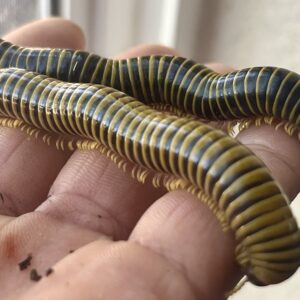
Eoperipatus totoro is not a worm, not a caterpillar, and not an arthropod. It belongs to Onychophora — a phylum of roughly 237 living species that sits alongside the arthropods rather than within them, and which has persisted largely unchanged for something close to 500 million years. Keeping one is as close as the hobby gets to keeping a Cambrian body plan.
Why the captive-bred part matters
Velvet worms are notoriously difficult. The published husbandry comparison is to dart frogs, and the overwhelming majority of animals that appear in the trade are wild-collected from small, fragmented populations. These are captive bred. That is the entire point of the work — Onychophora survived half a billion years and are now threatened by deforestation, and a species that breeds reliably in captivity no longer depends on collection to stay in the hobby.
We record parentage and origin for our accessions in SpeciesVault, so the lineage behind an animal is documented rather than asserted.
The species
Described in 2013 by Oliveira and colleagues from specimens collected in Cát Tiên National Park, southern Vietnam. It was the first velvet worm formally described from Vietnam and, as of 2024, remains the only one. The name is a nod to Miyazaki’s My Neighbour Totoro — the collectors had watched the film the evening they found the first specimen, and the many-legged Catbus reminded them of what they were looking at.
Peripatidae carry 23 pairs of legs in males and 24 in females. In the wild the species is found under stones and inside rotting wood in monsoon forest, chiefly during the November to June wet season.
How they hunt
Two glands beside the mouth fire jets of adhesive slime that harden within seconds, entangling prey at a distance before the animal moves in to feed. Very few animals have a projectile weapon at all; almost none use one like this.
Care
- Humidity: constant and high. They have permeable skin and no waterproof cuticle, so they dehydrate fast. The substrate must never dry out — and must never go stagnant either.
- Substrate: deep, moisture-retentive, with rotting hardwood and leaf litter to burrow through.
- Temperature: cool to moderate tropical. Avoid heat.
- Food: small live invertebrates — pinhead crickets, small roach nymphs, termites. Occasional rather than daily.
- Reproduction: live-bearing. No eggs to incubate.
- Experience: advanced. Not a first invertebrate.
Captive bred. Origin: Vietnam. Offered as 1-inch babies, singly or in threes.

Reviews
There are no reviews yet.