| Offered As | Single, Pair, 3 Count |
|---|

Uromastyx geyri
LizardsRed Uromastyx (Uromastyx geyri) For Sale
Price range: $250.00 through $690.00
Uromastyx geyri — the Saharan or Geyr’s spiny-tailed lizard, red phase. The species occurs in two colour phases, red and yellow, and colour is the only difference between them. Endemic to the Hoggar and Aïr mountains of Algeria, Mali and Niger, on rocky desert at 500–2,000 m. Babies at roughly 4–7 inches.
Provenance: farm bred. Not the same claim as captive bred — farm-bred animals are produced at a range-country facility from breeding stock held there, then exported. We label it as what it is rather than rounding it up.
CITES Appendix II. Every Uromastyx species has been on Appendix II since 1977, and U. geyri is assessed Near Threatened with declining wild populations. Appendix II governs international trade; documentation travels with the animal where it applies.
A desert herbivore, and the two things keepers get wrong are both dietary or thermal. It needs a genuine basking surface at 120–130°F with a cool end in the 80s, UVB, and a dry enclosure — humidity is what kills them. Feed a seed and greens diet; no insects as a staple, and no water bowl standing in a humid tank.
Quantity-managed listing: the animal you receive is representative of the group, not an individually pictured specimen.
Related products
- Lizards
Fire Skink (Lepidothyris fernandi) For Sale
Price range: $60.00 through $165.00 This product has multiple variants. The options may be chosen on the product page - Lizards
Red Eyed Crocodile Skink (Tribolonotus gracilis) For Sale
Price range: $250.00 through $690.00 This product has multiple variants. The options may be chosen on the product page - Lizards
White Eyed Crocodile Skink (Tribolonotus novaeguineae) For Sale
Price range: $200.00 through $550.00 This product has multiple variants. The options may be chosen on the product page - Lizards
Mexican Alligator Lizard (Abronia graminea) For Sale
Price range: $600.00 through $1,650.00 This product has multiple variants. The options may be chosen on the product page

Care questions
- What setup does a crocodile skink need?
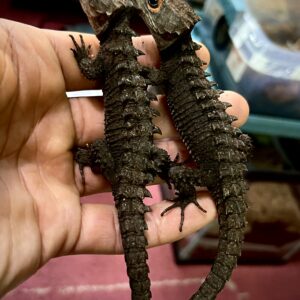
- A humid, heavily planted enclosure with deep leaf litter, plenty of cover and a shallow water area they can enter. They are semi-aquatic and secretive — visible hides and a moisture gradient matter more than floor space.
- Are crocodile skinks handleable?
- They are a display animal rather than a handling animal. Crocodile skinks are easily stressed, can vocalise when alarmed, and may drop their tail. They are best appreciated in a well-planted enclosure where they will behave naturally.
- Why does my crocodile skink hide constantly?
- That is normal behaviour, not a problem. In the wild they spend most of their time under leaf litter and near water. A skink with enough cover will emerge more often than one in a sparse enclosure, because it feels secure enough to.
- What do lizards eat?
- It depends entirely on the species — insectivores, omnivores and specialists all sit under the same word. This guide breaks the categories down. For the animals we sell, the species-specific requirement is stated in the listing.
- Do crocodile skinks need high humidity?
- Yes. Tribolonotus are forest-floor animals that need consistently damp substrate, a large water dish they can submerge in, and cover at ground level. Dry conditions cause shedding problems quickly.
- Why does my lizard do push-ups?
- It is territorial and social signalling rather than exercise or distress. The behaviour is explained here.
- What should healthy lizard droppings look like?
- A firm dark portion with a distinct white urate cap. Runny, discoloured or absent urates are worth investigating. There is a fuller reference here.

Reviews
There are no reviews yet.