

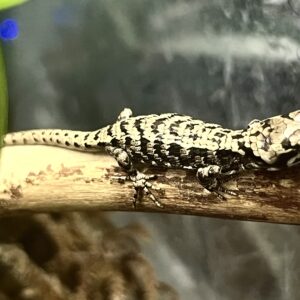
Babies of the Biak tree monitor, Varanus kordensis, offered at $2,850 each. The price on this page is the price per animal.
The animal
Varanus kordensis is the tree monitor of Biak, Supiori and Numfor, the Schouten Islands off the northwest coast of New Guinea, in Papua, Indonesia. It sits in the Varanus prasinus group, the emerald tree monitors: a long-bodied, long-tailed, arboreal lizard with a prehensile tail, not a ground monitor that happens to climb.
People asking for a “green tree monitor” are usually asking for one of three animals. Varanus prasinus is the emerald tree monitor of the New Guinea mainland and nearby islands. Varanus beccarii is the black tree monitor of the Aru Islands. Varanus kordensis is the Biak animal. The ranges do not overlap, and a listing that swaps the names is a different species. Babies are smaller and often brighter than the adults they grow into; adults are green to turquoise with dark markings across the body.
This listing is babies, sold individually, at $2,850 each.
Care
- Enclosure: tall, not long and low. Branches, cork tubes and a climbing surface the tail can grip. Tree monitors live off the floor.
- Temperature: a basking spot around 90–95°F, ambient air in the low-to-mid 80s, and a night drop into the 70s. Do not cook the whole cage.
- Humidity: high, roughly 70–90%, with enough airflow that the cage dries between mistings. Stagnant wet air is the usual husbandry failure, not a dry day.
- Light: UVB is worth providing. A day length with a clear photoperiod, not a bright white cage at midnight.
- Food: insects — roaches and crickets — as the staple. The prasinus group also takes the occasional egg and a little fruit. Dust and vary the insects.
- Keeper: hands-off. These are fast, nervous display animals. A Biak is not a lizard you take out to handle.
Questions this listing answers
What is a Biak tree monitor?
Varanus kordensis is the tree monitor native to Biak, Supiori and Numfor, off northwest New Guinea. It is a member of the emerald tree monitor group and a different species from Varanus prasinus and from the black tree monitor, Varanus beccarii.
How much is a Biak tree monitor baby?
Babies on this listing are $2,850 each.
Is the Biak tree monitor the same as an emerald tree monitor?
No. Emerald tree monitor is the usual name for Varanus prasinus. Biak tree monitor is Varanus kordensis. They are close, and they are not the same animal.
Is Varanus kordensis on CITES?
Yes. Varanus kordensis is covered by the genus listing on CITES Appendix II. A few other monitor species are on Appendix I; this is not one of them.
What enclosure does a Biak tree monitor need?
A tall arboreal enclosure with branches and cork, a warm basking spot, high humidity that is allowed to dry back, and insect prey. It is a display animal, not a handling animal.
Ships within the United States, or local pickup in Arvada, Colorado.

Reviews
There are no reviews yet.