
| Offered As | Single, Pair, 3 Count |
|---|

Thyropygus sp.
Invertebrates, MillipedesGiant Ember Millipede (Thyropygus sp.) For Sale
Price range: $150.00 through $490.00
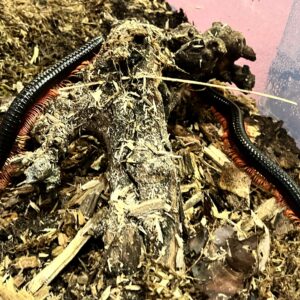
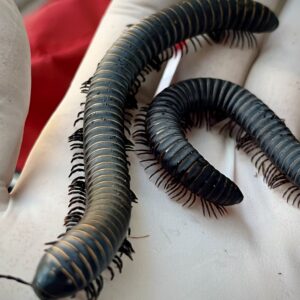
Field collected Thyropygus sp. — the Giant Ember, a Southeast Asian spirostreptid with warm ember banding down the body. Arriving at roughly 4–6 inches. Sold as Thyropygus sp. because the genus has not been revised and no one can honestly put a species name on this animal yet — see the registry for how we handle unresolved identifications. Not captive bred.
Harmless detritivore. Keep on 4–6 inches of deep decaying hardwood and leaf litter, kept moist — the substrate is the food, not decoration, and it gets eaten, so it is a repeat purchase. Provide cuttlebone or limestone permanently for the calcium the exoskeleton needs, and supplement with soft vegetables.
Quantity-managed listing: the specimen you receive is representative of the group, not an individually pictured animal.
Related products
- Invertebrates
Chocolate Spike Tail Millipede (Thyropygus allevatus) For Sale
Price range: $100.00 through $325.00 This product has multiple variants. The options may be chosen on the product page - Invertebrates
Sunset Leg Millipede (Alienostreptus bicoloripes) For Sale
Price range: $100.00 through $325.00 This product has multiple variants. The options may be chosen on the product page - Invertebrates
Odontostreptus Millipede (Odontostreptus sjoestedti) For Sale
Price range: $100.00 through $325.00 This product has multiple variants. The options may be chosen on the product page

Care questions
- What substrate do millipedes need?
- A deep layer — at least twice the length of the animal — of decaying hardwood, hardwood leaf litter and coco fibre. Millipedes eat their substrate, so it is food as much as bedding. Keep it consistently moist but never waterlogged, and never let it dry out completely.
- Do millipedes need a calcium source?
- Yes. Millipedes need calcium to harden their exoskeleton after each moult. Keep cuttlebone, crushed eggshell or limestone available at all times. Calcium deficiency is one of the most common causes of failed moults in captivity.
- What do millipedes eat?
- Decaying hardwood and leaf litter form the bulk of the diet. Supplement occasionally with vegetables such as cucumber, squash or sweet potato. Avoid citrus, and avoid anything treated with pesticides. Uneaten fresh food should be removed before it moulds.
- How long do millipedes live?
- Large tropical species commonly live several years in good conditions, and some individuals considerably longer. Longevity depends heavily on stable humidity, deep substrate and constant calcium access.
- Are millipedes safe to handle?
- They do not bite or sting. Many species secrete a defensive fluid that can stain skin and irritate eyes, so wash your hands after handling and never handle near your face. Support the animal fully and let it walk rather than gripping it.
- Can millipedes be kept with other animals?
- Millipedes are peaceful and are often kept in bioactive enclosures alongside other inhabitants. They do not predate. In a planted vivarium they will graze on decaying plant matter, which is generally beneficial.
- How are millipedes shipped?
- Packed in damp substrate with insulation appropriate to the season, and held back when temperatures at either end make transit unsafe. Every shipment is covered by our live arrival guarantee.
- Should I quarantine a new millipede?
- Yes. Keep new arrivals in a simple setup for a few weeks before adding them to an established bioactive enclosure. This gives you time to spot grain mites or an unusually heavy mite load on the animal, and to confirm it is feeding and moulting normally. Enclosure setup is covered here.
Reviews
There are no reviews yet.