

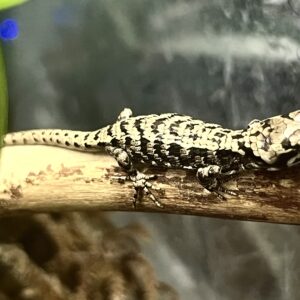
A baby black-throated monitor, Varanus albigularis ionidesi, at $500. One animal.
The animal
Varanus albigularis ionidesi is the black-throated monitor, a subspecies of Varanus albigularis, the white-throated or rock monitor of sub-Saharan Africa. The subspecies is the East African animal, named for C. J. P. Ionides, and it is the heavy-bodied one keepers mean when they say black throat. It is not a tree monitor, not a savannah monitor (Varanus exanthematicus), and not a Nile monitor (Varanus niloticus).
Babies are banded and small enough to underestimate. Adults are among the largest lizards kept in private collections: a long, muscular terrestrial animal that needs floor space, a hot basking site, and a cage it cannot shove open. Plan for the adult when you buy the baby. The price of this listing is $500 for a baby.
Care
- Enclosure: long and terrestrial. Floor space matters more than height. A secure lid and locked doors — an adult black throat is strong enough to exploit a weak screen.
- Temperature: a hot basking surface, a warm ambient side, and a retreat that is not sitting on the basking slate. These are open-country lizards, not cloud-forest animals.
- Humidity: a dry cage with a humid hide. Do not keep it swamp-wet. Do not keep it so dry the hide is useless.
- Food: insects while it is small. The diet gets larger as the lizard does. Vary it. Do not raise it on a single feeder.
- Keeper: intermediate, and only if the adult enclosure is already the plan. This is not a first lizard and it is not a handling pet.
Questions this listing answers
What is a black throat monitor?
The black-throated monitor is Varanus albigularis ionidesi, the East African subspecies of the white-throated monitor. It is a large terrestrial monitor, not a tree monitor.
How much is a baby black throat monitor?
This baby is $500.
How big does a black-throated monitor get?
Much larger than the baby in front of you. Adults are heavy, long, and strong. Buy it only if the adult cage is the one you are willing to own.
Is a black throat monitor a savannah monitor?
No. Savannah monitor is Varanus exanthematicus. Black-throated monitor is Varanus albigularis ionidesi.
Is it CITES listed?
Yes. It is covered by CITES Appendix II through the genus Varanus.
Ships within the United States, or local pickup in Arvada, Colorado.

Reviews
There are no reviews yet.